
India's two-wheeler industry is seen growing 6-9% in 2026, though a proposed ABS mandate for sub-125cc models could push up prices and temper volumes.

The GST Council on Wednesday approved a two-tier rate structure of 5 and 18 per cent, which will be implemented from September 22.

The Indian economy is likely to grow at 7.4 per cent in 2025-26, up from 6.5 per cent in the previous fiscal, mainly on account of better performance of manufacturing and services sectors, as per the government data released on Wednesday.

Investors and startup executives are calling for extending the period for an entity to be recognised as a startup from 10 to 15 years for deep-tech companies.

Here are the key numbers to watch out for in the Union Budget for 2025-26:

The proposed 'Next Gen GST' with sweeping reforms, lower tax rates, and just two slabs, aims to boost the economy amid tariff threats and set the stage for a single tax rate regime by the time India becomes a developed nation, government sources said.


Auto majors Maruti Suzuki, Tata Motors and Mahindra & Mahindra reported robust sales in September as reduced price tags owing to GST rationalisation led to record demand in the Navaratri period. The month also saw Tata Motors and Mahindra & Mahindra settling at number two and three positions, respectively in vehicle wholesales ahead of Hyundai Motor India.

Fitch Ratings on Thursday raised India's GDP growth forecast for the current fiscal to 7.4 per cent, from 6.9 per cent, on increased consumer spending and improved sentiment boosted by GST reforms.

India's net revenues from the Goods and Services Tax (GST) rose at a three-month high pace of 10.7 per cent in August even as growth in gross collections slowed to 6.5 per cent from 7.5 per cent in the previous month, thanks to a nearly 20 per cent decline in refunds to taxpayers during the month.

As lower GST rates take effect on Monday, sales of air-conditioners, TV sets surged dramatically with buyers rushing to grab cheaper deals offered by retailers at the beginning of the Navratra festival.

Some of the key names include: Maruti, M&M, Ashok Leyland, Britannia, Ultratech, JK Cement, Havells, Voltas, Amber, Metro, Trent, LemonTree, Indian Hotels, Niva Bupa, HDFC Life, IGL, Acme Solar, Suzlon, Swiggy, Delhivery, ICICI Bank, HDFC Bank, Bajaj Finance, Shriram Finance," according to a report by Motilal Oswal Financial Services.
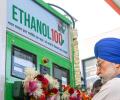
As of now, no firm has launched a flex-fuel vehicle in India, as these models are more expensive than comparable petrol-run vehicles.

The loss of input tax credit (ITC) following the rationalisation of the goods and services tax (GST) on individual life and health insurance from 18 per cent to nil is may weigh on the profits of life insurers in the third quarter (Q3) of 2025-26 (FY26).

Nagaland Governor Ajay Kumar Bhalla announced the state government's plans to form an interim council for the Frontier Nagaland Territorial Authority (FNTA) and highlighted key achievements and future priorities across various sectors during the Budget Session.

Skoda India is focusing on cleaner fuel options, including CNG and EVs, while compact SUV Kylaq drives volumes, expands first-time buyers and strengthens the brand in India's competitive market

The life and non-life insurance industries are hopeful of a reduction in the goods and services tax (GST) on health and life insurance premiums, after Prime Minister Narendra Modi, in his speech on Friday, announced GST relaxations aimed at providing relief to ordinary citizens, farmers, the middle class, and the small and medium enterprises (MSME) sector.

Consumer durables makers are hopeful that the government's proposal to reduce goods and services tax (GST) on air conditioners and television panels above 32 inches to 18 per cent would help revive the sector.

President Droupadi Murmu addressed the nation on the eve of Republic Day, emphasising India's role in promoting peace, the empowerment of women, and the country's economic growth.

The Union Cabinet, meeting at the new PMO complex 'Seva Teerth', resolved to prioritize citizen empowerment and service in all its decisions, guided by the principle of 'Nagrik Devo Bhava'.

The rationalisation of goods and services tax (GST), announced on Wednesday, directly lowers the cost of everyday medical consumables, and also high-end therapies in oncology and rare diseases, helping reduce out-of-pocket patient expenditure and better adherence to medication.
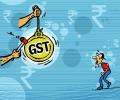
The State Bank of India (SBI) in its latest research report said that reforms in GST through reduction in rates will cause a minimal revenue loss of Rs 3,700 crore. The government estimates the net fiscal impact of GST rates rationalisation will be Rs 48,000 crore on an annualised basis.

Data from used-car platforms suggest that buyer preferences have remained broadly stable post-GST, with SUVs retaining their dominance even as price adjustments played out across segments.

rediffGURUS Mihir Tanna, Vipul Bhavsar, T S Khurana, Vivek Lala and Anil Rego will answer your tax queries related to the Union Budget 2026-2o27.

Highlights of the Economic Survey 2025-26

Mahindra & Mahindra on Saturday said it has reduced prices of its passenger vehicle range by up to Rs 1.56 lakh with immediate effect in order to pass on GST rate cut benefit to customers. The price cut follows the announcement of revamped GST at the 56th GST Council meeting held on September 3, 2025, the Mumbai-based auto major said in a statement.
Finance Minister Nirmala Sitharaman's biggest challenge will be to find a new growth driver, particularly against the backdrop of a global economy ravaged by heightened uncertainty and fragmentation, financial markets on a precipice, and global commodity prices on a continued uptrend.

Driven by GST reforms, robust festive demand, and softening raw material prices, the FMCG industry expects volume-based growth, supported by a mid-single digit revenue rise and improved operating margins in the December quarter.

Business confidence in India Inc rose to a five-quarter high in December quarter of FY26, amid further reform expectations and steady domestic demand, a survey by industry body Confederation of Indian Industry (CII) showed. The CII Business Confidence Index (BCI) rose for the third consecutive quarter to 66.5 in the December quarter from 66 in the preceding September quarter.

Trade deals ease risks for Indian equities, but weak demand and stretched valuations raise questions over whether optimism -- especially in smallcaps -- can turn into a sustained bull run, points out Debashis Basu.

Daily essentials and food products will be cheaper from Monday, as leading FMCG companies have slashed prices, extending GST cut benefits to consumers.
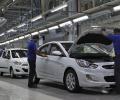
Leading automakers Maruti Suzuki, Hyundai, Mahindra, and Tata Motors saw a dip in dispatches to dealers in August amid dip in demand with many prospective buyers postponing their buys anticipating a reduction in vehicle prices on account of the new GST framework. The country's largest carmaker Maruti Suzuki India reported an 8 per cent year-on-year dip in dispatches of passenger vehicles in the domestic market last month.
Among Sensex firms, Tata Motors rose the most by 3.5 per cent while Adani Ports gained 3.16 per cent. Reliance Industries rose by 2.82 per cent. Eternal, Tech Mahindra, Kotak Mahindra Bank, Hindustan Unilever and Maruti were also among the gainers. However, Bajaj Finserv, Power Grid, Mahindra & Mahindra and HCL Tech were among the laggards.

The country's largest carmaker Maruti Suzuki India expects auto sales to bounce back to the glory days of 7 per cent growth by FY 27, helped by the proposed GST rate cut which is expected to bring down car prices by 3.5 to 8.5 per cent.

'The trade deficit in some sectors is huge and that is an area of opportunity to localise.'

Hindustan Unilever Limited's (HUL's) standalone revenue grew 4.4 per cent year-on-year (Y-o-Y), while volume rose 3.5 per cent during the third quarter of financial year 2026 (FY26).

Renault India on Saturday said it will reduce prices of its vehicles by up to Rs 96,395 to pass on full benefit of the recent GST rate cut to buyers. The GST Council, earlier this week, approved limiting slabs to 5 per cent and 18 per cent, effective from September 22.

Among Sensex firms, Maruti zoomed the most by 8.94 per cent. Bajaj Finance rallied over 5 per cent, UltraTech Cement by 3.71 per cent, and Bajaj Finserv by 3.7 per cent. Mahindra & Mahindra, Hindustan Unilever and Trent were also among the gainers. However, ITC was the biggest loser, dropping by 1.26 per cent. Eternal, Tech Mahindra and Larsen & Toubro also declined.

The idea of back-loading the target of fiscal consolidation is perhaps guided by the government's desire to be prepared for any adverse developments in the coming year, points out A K Bhattacharya.

Three laws passed in Parliament could boost central revenues, reshape GST cess flows, shift MGNREGA costs to states and create new budget headroom ahead of the 2026-2027 Union Budget, points out A K Bhattacharya.
 © 2026 Rediff.com - Advertise with us - Disclaimer - Privacy Policy - Sitemap - Feedback - About us - Terms of use - Grievances